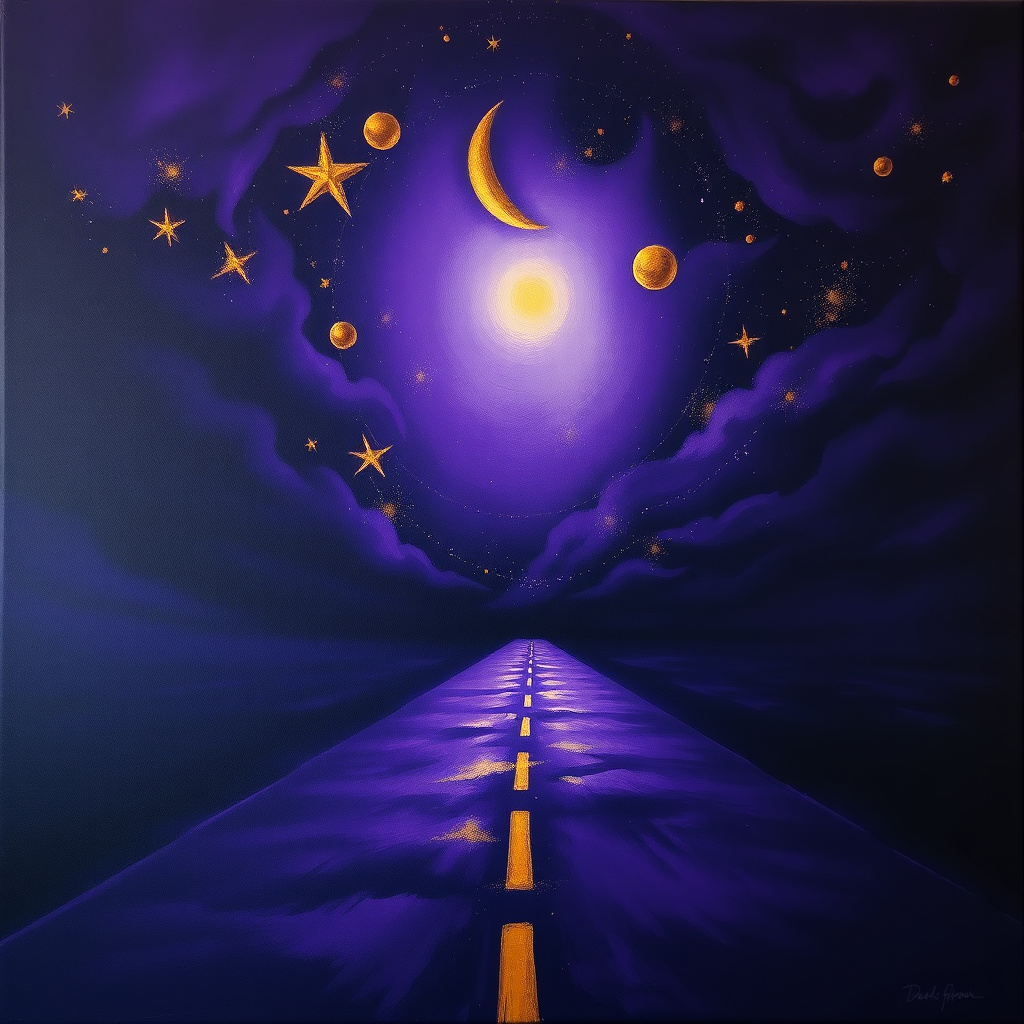
Road Dream Meaning: A Historical Evolution of Interpretation
Explore the shifting historical perspectives of the road symbol, from ancient Greek prophecies and medieval omens to Victorian spiritualism and modern neuroscience.
The road serves as one of the most enduring archetypes in human consciousness, yet the lens through which we view its appearance in sleep has undergone radical shifts. To understand a road dream meaning, one must look beyond contemporary psychology and examine how human civilizations have historically assigned weight to the concept of a path. From the divine decrees of antiquity to the synaptic firing patterns of the modern era, the road has transitioned from a literal message from the gods to a complex neurological map of the waking self.
What does your Road dream mean?
Identify the historical era that most aligns with your current perspective:
The Ancient and Medieval Concept of the Road as Divine Decree
In the classical era, particularly within Greek and Roman traditions, the appearance of a road was rarely viewed as a product of the individual's internal psyche. Instead, it was treated as a prophetic vessel. To encounter a road in a dream was to receive a topographical instruction from the gods or the Fates. If the path was straight and sunlit, it was interpreted as an external validation of a mortal's destiny, a literal sign that the cosmos had cleared a way for their specific purpose. The road was not a metaphor for the mind; it was a physical manifestation of the divine will laid out upon the earth. During the transition into the medieval period, this externalization persisted but took on a more moralistic, omen-based quality. In the medieval worldview, the road functioned as a spiritual corridor between the earthly realm and the celestial or infernal territories. A road appearing in a dream was often scrutinized for its condition as a sign of one's standing in the eyes of the divine. A crumbling, overgrown, or bifurcated path was not seen as a reflection of personal anxiety, but as a tangible warning of moral decay or a spiritual crossroads where a soul might deviate from the righteous way. The road was a map of salvation or damnation, an objective reality that existed outside the dreamer, dictating the trajectory of their life through external signs rather than internal impulses. In these eras, the road was a bridge between the human and the supernatural, a fixed architecture of fate that demanded obedience rather than introspection.
Victorian Spiritualism and the Road as a Soul's Transit
As the industrial revolution reshaped the physical landscape, the interpretive framework for the road underwent a significant pivot during the Victorian era. With the rise of spiritualism and the fascination with the afterlife, the road began to shed its purely prophetic, external character and became a symbol of the soul's movement between planes of existence. Victorian interpreters often viewed the road in a dream as a medium for communicating with the departed or for navigating the 'veil' between the living and the dead. The road was no longer just a path through a physical landscape or a divine decree; it was a metaphysical conduit. In the context of 19th-century séances and spiritualist literature, a road appearing in the sleeping mind might be interpreted as a wayfarer's journey in the spirit world. The focus shifted toward the concept of the 'long journey' of the essence, where the road represented the continuity of consciousness beyond the biological termination of life. This period introduced a layer of romanticism and melancholy to the symbol. The road became a site of longing, a way to visualize the distance between the material world and the ethereal realms. While still maintaining a degree of external mystery, the Victorian perspective began to tie the road more closely to the individual's spiritual identity and their connection to the unseen forces of the universe. It was a transitional period where the road functioned as a bridge between the rigid, deterministic paths of the past and the more subjective, internal explorations that would characterize the coming century of psychological inquiry.
The Modern Neuroscientific Paradigm of the Road
In the contemporary era, the interpretation of the road has been stripped of its divine and ethereal ornamentation, replaced by the rigorous frameworks of neuroscience and cognitive psychology. Today, when analyzing a road dream meaning, researchers look toward the brain's way of processing spatial navigation and sequential logic. From a neuroscientific perspective, the road is viewed as a visual representation of the brain's attempt to organize complex information into a linear, navigable structure. The road is an emergent property of the hippocampus and the prefrontal cortex, simulating the way the mind anticipates future sequences or reviews past trajectories. Instead of a message from a deity or a sign from a spirit, the road is seen as a cognitive heuristic—a mental shortcut used to model progress, obstacle avoidance, and goal-oriented behavior. Modern theory suggests that the road is a projection of the brain's executive functions. When the mind encounters a road in sleep, it is often simulating the 'logic of the path' to resolve conflicts in decision-making or to consolidate memories of movement and direction. The focus has moved entirely inward; the road is a topographical map of the dreamer's own neural architecture and cognitive processing. It is a simulation of agency, where the brain uses the visual metaphor of a path to rehearse the complexities of navigating a multifaceted reality. This shift represents the final move from the road as a celestial map to the road as a biological construct, where the 'path' is nothing more than the brain's way of rendering the concept of time and causality into a coherent, visual sequence.
Frequently Asked Questions
What is the significance of a road dream meaning in a historical context?
Historically, the road has shifted from a divine prophetic sign in ancient Greece to a moral omen in the Middle Ages, a spiritual conduit in Victorian times, and finally to a cognitive simulation of decision-making in modern neuroscience. Its meaning depends entirely on the era's prevailing understanding of reality and consciousness.
How does a dream about road conditions change based on these eras?
In ancient times, a rough road was a sign of divine displeasure. In the Victorian era, it might represent the difficulty of the soul's passage. In modern terms, it is viewed as the brain's way of modeling perceived obstacles or cognitive friction during the processing of complex life sequences.
Why do people search for road dream meaning so frequently?
People search for this because the road is a universal archetype for the passage of time and the direction of life. Whether viewed through the lens of ancient fate or modern neurology, the road provides a visual framework for understanding how we navigate our existence and our choices.