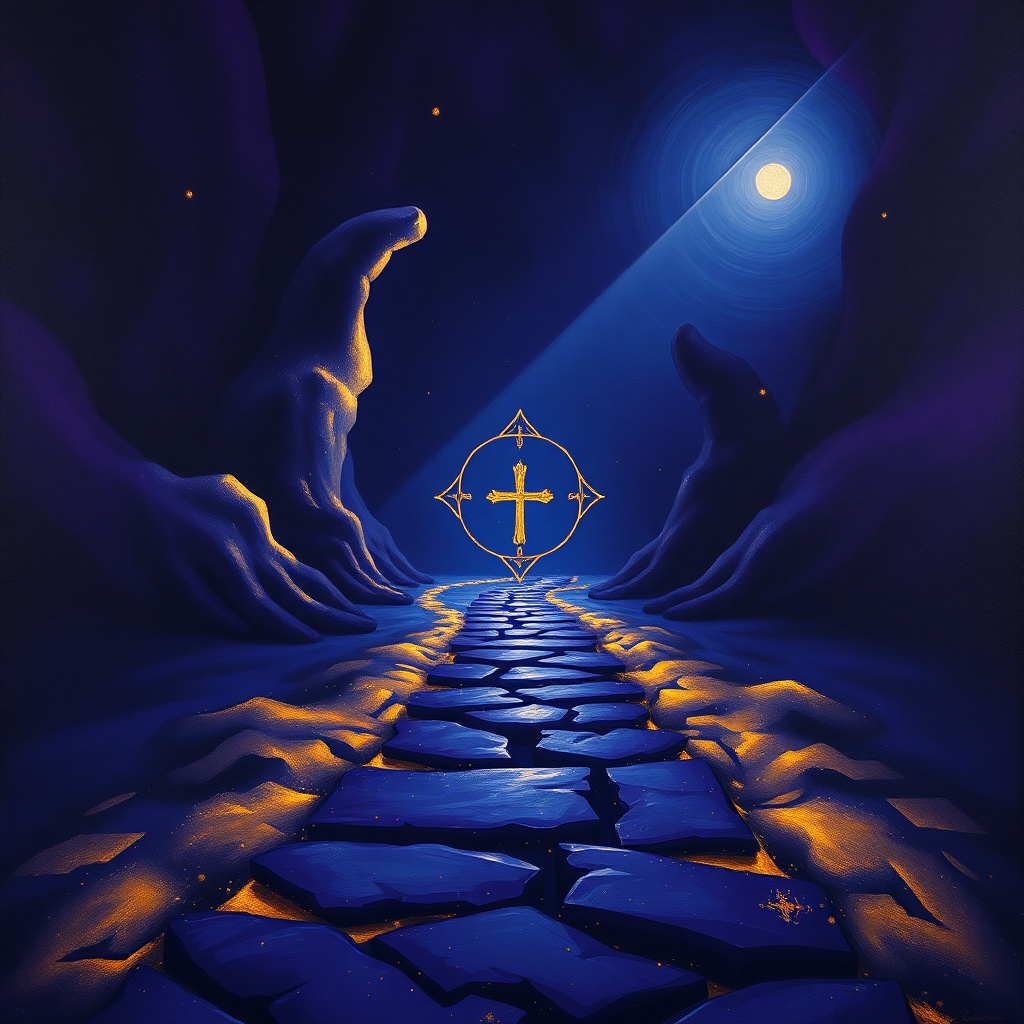
Path: A Jungian Archetypal Analysis of the Psychic Trajectory
Explore the psychological significance of the Path through a Jungian lens, focusing on individuation, the shadow, and the architecture of the collective unconscious.
In the realm of analytical psychology, a Path functions as more than a mere directional marker; it is a psychic structure representing the movement of the ego toward the Self. From a Jungian perspective, encountering a Path suggests the soul's attempt to navigate the complex topography of the psyche. It serves as a topographical map of the individuation process, tracing the tension between the conscious persona and the vast, uncharted depths of the collective unconscious. To engage with the Path is to engage with the teleological drive of the human spirit to achieve psychic wholeness.
What does your Path dream mean?
Identify the primary quality of the Path's terrain:
The Path as the Architecture of Individuation
Carl Jung posited that the primary goal of human development is individuation—the process by which a person becomes their true, whole self by integrating various psychic elements. Within this framework, the Path acts as the formal manifestation of this teleological journey. It is the structural representation of the ego's movement away from mere social conformity and toward the realization of the Self. Unlike a casual stroll in waking life, a psychic Path implies a directedness, a necessity of movement toward a specific psychological destination. When the psyche presents a Path, it is often highlighting the distinction between the 'way of the world'—the collective expectations and social roles—and the 'way of the soul.' This distinction is vital for understanding the tension between the persona, our social mask, and the authentic core. A clear, well-defined Path may indicate that the ego is successfully aligning with the unconscious imperatives of growth, whereas a fragmented or disappearing Path suggests a disruption in the individuation process. This disruption often occurs when the ego refuses to acknowledge the necessity of integrating repressed material. In the context of depth psychology, the Path is not a destination one reaches, but the very mechanism of becoming. It is the longitudinal axis upon which the various archetypal forces interact, allowing the individual to move through the stages of psychological maturation. Therefore, the Path is less about 'where one is going' in a literal sense and more about 'how one is unfolding' as a unique psychological entity, navigating the intricate dialectic between the conscious mind and the profound mysteries of the unconscious realm.
Navigating the Shadow through the Psychical Way
The Path frequently serves as the primary theater for the encounter with the Shadow—the repository of all qualities, impulses, and traits that the ego has deemed unacceptable. In Jungian theory, one cannot achieve wholeness without descending into the darker aspects of the psyche. The Path, therefore, often leads through territories of uncertainty, darkness, or perceived danger, which are symbolic representations of the Shadow's domain. These 'difficult stretches' of the Path are not obstacles to be avoided, but essential stages of integration. To bypass the Shadow is to remain stuck in a state of psychic inflation or superficiality. When a Path turns into a narrow, claustrophobic passage or a descent into a subterranean tunnel, the psyche is demanding a confrontation with the unlived life. This is where the tension of opposites is most acute. The Path provides the necessary boundary that allows the ego to approach the Shadow without being completely overwhelmed by it. It offers a sense of continuity even when the contents of the unconscious are chaotic. In the movement along the Path, the individual learns to recognize the Shadow not as an external enemy, but as a vital, albeit disowned, part of the total personality. This integration is a prerequisite for the next stage of development. Without the willingness to follow the Path into these liminal, shadowed spaces, the psychic energy remains stagnant, preventing the emergence of a more complex and resilient ego. Thus, the Path acts as a bridge between the light of conscious awareness and the fertile, though often frightening, darkness of the repressed self.
Anima/Animus and the Path toward the Self
As the individual progresses along the Path, they inevitably encounter the archetypes of the Anima or Animus—the contrasexual elements of the psyche that serve as mediators between the ego and the collective unconscious. In Jungian thought, these figures act as psychopomps, or soul-guides, who facilitate the movement toward the Self. The Path is the medium through which these archetypal energies are channeled and experienced. An encounter with the Anima/Animus often occurs at critical junctions or 'crossroads' on the Path, marking a transition from personal development to a more profound, universal level of consciousness. These archetypal guides provide the emotional and intuitive depth necessary to navigate the complexities of the unconscious. If the Path is viewed as the axis of the psyche, the Anima/Animus represents the vitalizing force that prevents the journey from becoming a purely intellectual or ego-driven exercise. They inject the necessary 'soul' into the process of individuation, ensuring that the ego remains connected to the deeper, more instinctual layers of being. This encounter can be both transformative and destabilizing, as it requires the ego to relinquish its absolute control and yield to the irrational, spontaneous wisdom of the unconscious. The Path, in this sense, is a sacred geometry that guides the individual through the various layers of the psyche, from the superficial persona to the profound union of opposites. Ultimately, the successful navigation of the Path, facilitated by these archetypal mediators, leads to the 'circumambulation' of the Self—a movement that is not linear, but circular, constantly returning to the center of psychic unity from an ever-expanding circumference of experience.
Frequently Asked Questions
What is the path dream meaning in a Jungian sense?
In Jungian psychology, the meaning of a path relates to the process of individuation. It is seen as the structural representation of the ego's journey toward psychological wholeness and the integration of the Self. It signifies the movement through various archetypal stages, including the confrontation with the Shadow and the guidance of the Anima or Animus.
How should I interpret a dream about path obstacles?
Obstacles on a path are interpreted as psychic resistance or the presence of Shadow material. They represent the necessary tensions and conflicts that must be resolved to achieve further psychological growth. Rather than seeing them as failures, view them as indicators of where the ego must integrate disowned aspects of the personality.
Does a path dream indicate a specific direction in life?
From a depth psychology perspective, the path does not predict external life events or career moves. Instead, it reflects the internal trajectory of the psyche. It indicates the state of your individuation process and how effectively your conscious ego is navigating the demands and energies of the collective unconscious.