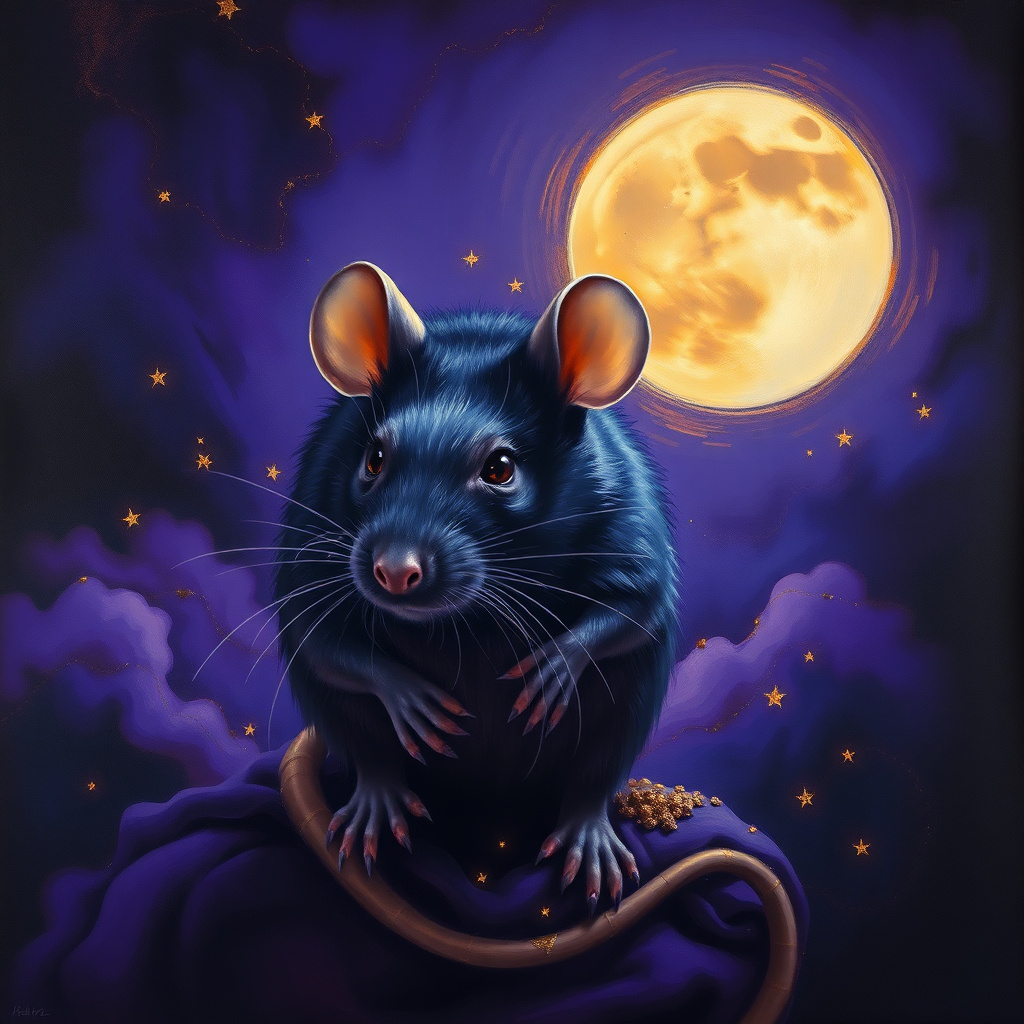
Rat Dream Meaning: An Evolutionary History of Interpretation
Explore how the Rat has shifted from an ancient omen to a modern neurological signal in dream interpretation through historical and cultural lenses.
The Rat occupies a unique position in the human psyche, acting as a biological mirror to our changing relationship with the unseen. To understand why a Rat appears in the sleeping mind, one must look beyond contemporary anxieties and examine the shifting tides of human history. From the divine warnings of antiquity to the synaptic firing of the modern era, the perception of this rodent has undergone a radical metamorphosis. This entry examines the Rat not as a static object, but as a fluid emblem that evolves alongside our understanding of the natural and spiritual worlds.
What does your Rat dream mean?
Identify the era that most closely aligns with your current perspective on dreams:
Antiquity and the Medieval Era: The Rat as Divine Omen
In the ancient Mediterranean, the appearance of a Rat was rarely viewed as a mere biological occurrence; it was frequently cataloged within the framework of oneiromancy. To the Greeks, a dream involving a Rat was often interpreted through the lens of celestial causality. If a Rat appeared in a prophetic vision, it was frequently linked to the concept of 'miasma'—a spiritual contagion or an imbalance in the cosmic order. The Rat was not a psychological manifestation but a messenger of impending physical or social decay, a sign that the gods were withdrawing their favor from a specific household or city-state. This perspective treated the Rat as an external agent of fate, a harbinger of rot that existed independently of the dreamer's personality. As the timeline progressed into the Medieval period, this interpretation hardened into a strictly moralistic framework. The Rat became a potent emblem of subterranean vice and the corruption of the soul. Within the theological structures of the Middle Ages, the Rat was viewed through the lens of the 'unclean.' Its presence in a dream was often parsed as a spiritual warning regarding the encroachment of sin or the presence of hidden treachery within one's community. The rodent's ability to navigate the dark, hidden spaces of a structure served as a metaphor for the way temptation infiltrates the human heart. Unlike the Greek view of cosmic imbalance, the Medieval interpretation was deeply personal and punitive, framing the Rat as a shadow-agent of the devil, meant to signal a lapse in piety or the presence of a 'rat' in the social fabric—a person of low moral standing or a betrayer of faith.
Victorian Spiritualism and the Rat as a Psychic Residue
The 19th century brought a seismic shift in how the Rat was perceived, moving away from communal religious morality toward the individualistic explorations of Victorian Spiritualism. During this era, the rise of séances and the study of the 'ether' transformed the Rat into a symbol of psychic residue. As people began to investigate the boundaries between life and death, the Rat was often interpreted as a manifestation of 'ectoplasmic' or lingering energy. Rather than a sign of sin, a Rat in a dream might be viewed as a signifier of a disturbed psychic environment or the presence of a 'low-vibration' spirit attempting to communicate from the periphery of consciousness. In this period, the Rat was also heavily influenced by the industrialization of the era. The urban landscape, teeming with rodents, led to a dualistic interpretation: the Rat was both a symbol of the grit of the modern city and a medium for the 'subconscious'—a term then gaining traction. Victorian occultists might see the Rat as a guide through the 'lower astral planes.' The creature's ability to thrive in the dark corners of the expanding industrial metropolises mirrored the Victorian fascination with the 'underworld' of the human mind. The Rat was no longer just a divine messenger or a moral warning; it became a symbol of the hidden, often unpalatable, layers of the individual psyche that were being unearthed by the burgeoning science of psychology. This era bridged the gap between the external omen and the internal ghost, preparing the way for the modern era's focus on the biological mechanisms of the brain.
Modernity and Neuroscience: The Rat as Synaptic Processing
In the contemporary era, the interpretation of a Rat has undergone its most radical transformation, moving from the celestial and spiritual to the strictly biological. With the advent of neuroscience, the dream is no longer viewed as a message from the gods or the astral plane, but as the byproduct of synaptic pruning and memory consolidation. In this light, a Rat appearing in a dream is interpreted as a piece of 'neural data.' It is a manifestation of the brain's attempt to categorize and process sensory input, often related to survival instincts or the recognition of patterns associated with scavenging, threat detection, or environmental navigation. Modern cognitive science suggests that the Rat represents the brain's 'bottom-up' processing—the way our primal, limbic system reacts to stimuli. When a dreamer encounters a Rat, current theory posits that the brain is utilizing a familiar, high-arousal archetype to process feelings of hyper-vigilance or the detection of 'errors' in one's waking environment. The Rat is a biological heuristic, a shortcut the brain uses to represent complex concepts of resource management or environmental toxicity. We have stripped the Rat of its divine agency and its spiritual weight, replacing them with the mechanics of the amygdala. Instead of asking what the Rat means for our soul, we now ask what specific neurological pathway or evolutionary survival mechanism is being triggered. The Rat has transitioned from a harbinger of fate to a biological artifact of the human brain's sophisticated, albeit ancient, pattern-recognition software.
Frequently Asked Questions
What is the general rat dream meaning?
Historically, the meaning of a Rat in a dream has shifted from a divine omen of decay to a modern neurological signal. While ancient cultures saw it as a sign of cosmic imbalance, modern perspectives view it as a manifestation of the brain's primal survival mechanisms and pattern recognition.
How do I interpret a dream about a rat in a modern context?
In a modern context, rather than looking for spiritual omens, focus on the biological and psychological triggers. Consider if the Rat represents a 'bottom-up' processing of environmental stressors, such as feelings of hyper-vigilance or the brain's attempt to categorize perceived threats or 'errors' in your daily life.
Does a rat dream meaning change based on history?
Yes, significantly. An ancient Greek might see a Rat as a sign of divine displeasure, a Medieval person might see it as a symbol of moral corruption, a Victorian might see it as a psychic residue, and a modern person sees it as a byproduct of neural processing.