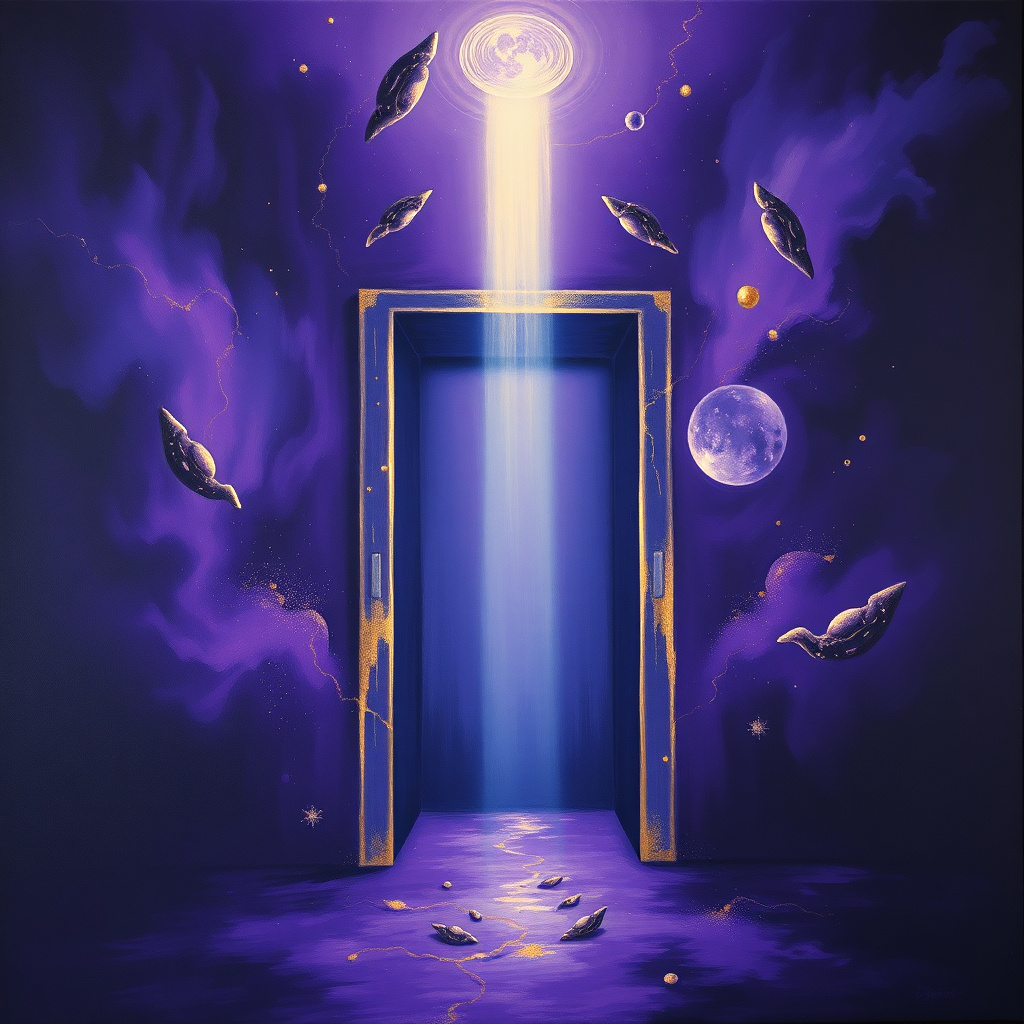
Elevator Dream Meaning: A Historical Evolution of Interpretation
Explore how the elevator has shifted from a non-existent concept in ancient prophecy to a modern psychological marker of vertical movement and control.
The elevator is a relatively modern addition to the human subconscious lexicon. Unlike the moon or the sea, which have occupied the dreamscape for millennia, the elevator is a product of industrialization and urban density. Because it did not exist in the classical era, its appearance in a dream functions as a temporal marker. To understand its significance, one must trace how the human mind has transitioned from interpreting verticality as divine movement to viewing it as a mechanical process of the psyche, shifting from omens of the heavens to the mechanics of modern life.
What does your Elevator dream mean?
What is the primary direction of the elevator's movement?
From Divine Ascent to Omens: Pre-Industrial Verticality
In the era of ancient Greek prophetic dreams or medieval mysticism, the concept of an 'elevator' was physically impossible, yet the sensation of rapid vertical movement was deeply ingrained in the cultural psyche. An ancient dreamer experiencing a sudden lift would not have conceptualized a machine; instead, they would have interpreted the sensation as an encounter with the divine or a visitation from a deity. In Greek thought, moving upward was synonymous with the soul's proximity to Olympus. A dream of rising quickly would be recorded by a priest as a sign of celestial favor or a direct communication from the gods. Conversely, a sudden descent was not viewed as a mechanical failure but as a descent into the underworld or a divine punishment. During the medieval period, this verticality shifted toward the moralistic. A rapid ascent might be seen as an omen of sainthood or spiritual elevation, while a sudden drop was often interpreted as a descent into sin or a warning of demonic influence. The 'elevator' sensation, therefore, was stripped of its mechanical identity and was instead a vehicle for moral and theological assessment. There was no distinction between the movement and the message; the direction was the destiny. While we now view these movements through the lens of personal progress or anxiety, the historical predecessor to the elevator dream was a cosmic barometer, measuring the distance between the mortal realm and the eternal heavens, governed by fate rather than physics.
Victorian Spiritualism and the Mechanical Soul
With the advent of the Industrial Revolution and the widespread installation of elevators in urban architecture, the symbol underwent a profound shift. During the Victorian era, the elevator entered the collective unconscious as a symbol of the tension between new technology and the burgeoning field of spiritualism. As cities grew taller, the elevator became a bridge between the grounded, material street level and the lofty, detached upper floors of wealth and status. In the dream interpretations of this period, the elevator began to mirror the soul's journey through a structured, often rigid, social and spiritual hierarchy. Spiritualists might have viewed the elevator as a metaphor for the 'etheric plane'—a controlled, mechanical way to move between different states of consciousness. However, there was a distinct anxiety regarding the loss of control. The machine was a marvel, but it was also an external force that could malfunction. A dream involving an elevator failing or moving erratically was often linked to the fear of losing one's social standing or the terrifying realization that the modern world was becoming too fast and too automated. The elevator became a symbol of the 'controlled ascent,' reflecting a society that was obsessed with climbing the social ladder while simultaneously fearing the mechanical instability of their rapidly changing environment. It was no longer just about gods or demons; it was about the precariousness of human agency within a massive, unfeeling industrial framework.
Modern Neuroscience and the Mechanics of the Psyche
In the contemporary era, the interpretation of the elevator has moved away from the celestial and the social, landing firmly within the realm of neuroscience and cognitive psychology. We no longer view the elevator as a divine chariot or a Victorian status symbol; instead, we see it as a manifestation of the brain's processing of agency, control, and equilibrium. Modern psychological frameworks treat the elevator as a metaphor for the internal 'up and down' of emotional regulation and cognitive states. When a person dreams of an elevator going up fast or dropping suddenly, neuroscientists and modern therapists often look toward the dreamer's perceived control over their waking life circumstances. The elevator represents a closed system—a confined space where the individual is a passenger to external forces. This mirrors the biological reality of how the brain processes sudden shifts in stimulus or stress. A dream of an elevator not working or malfunctioning is seen as a cognitive reflection of perceived helplessness or the breakdown of routine. The 'sideways' movement or the 'wrong floor' are interpreted as disruptions in the logical progression of life goals or a misalignment between intention and outcome. We have effectively demystified the symbol, moving from the 'why' of divine will to the 'how' of neurological response. The elevator is now a tool for mapping the internal landscape of the self, representing the fluctuating levels of consciousness and the perceived stability of the individual's mental and emotional architecture.
Frequently Asked Questions
What does it mean to dream about an elevator falling or crashing?
Historically, this would have been a terrifying omen of a fall from grace. In a modern context, it typically reflects a perceived loss of control in a high-stakes situation. The sensation of a crash mirrors the psychological fear of a sudden, catastrophic failure in one's professional or personal life, where the 'mechanics' of your daily stability seem to be breaking down.
How should I interpret an elevator going to the wrong floor?
This is a modern manifestation of misalignment. It suggests that while you are moving (progressing), you are not arriving at the intended destination. It reflects a disconnect between your current efforts and your actual life objectives, indicating that your current trajectory may be misdirected despite your continuous movement.
What is the significance of an elevator going up and not stopping?
This reflects a sense of momentum that has become unmanageable. While upward movement is traditionally positive, the inability to stop suggests an anxiety regarding hyper-growth or a lack of boundaries. It is the feeling that a situation in your waking life is accelerating beyond your capacity to regulate or enjoy it.