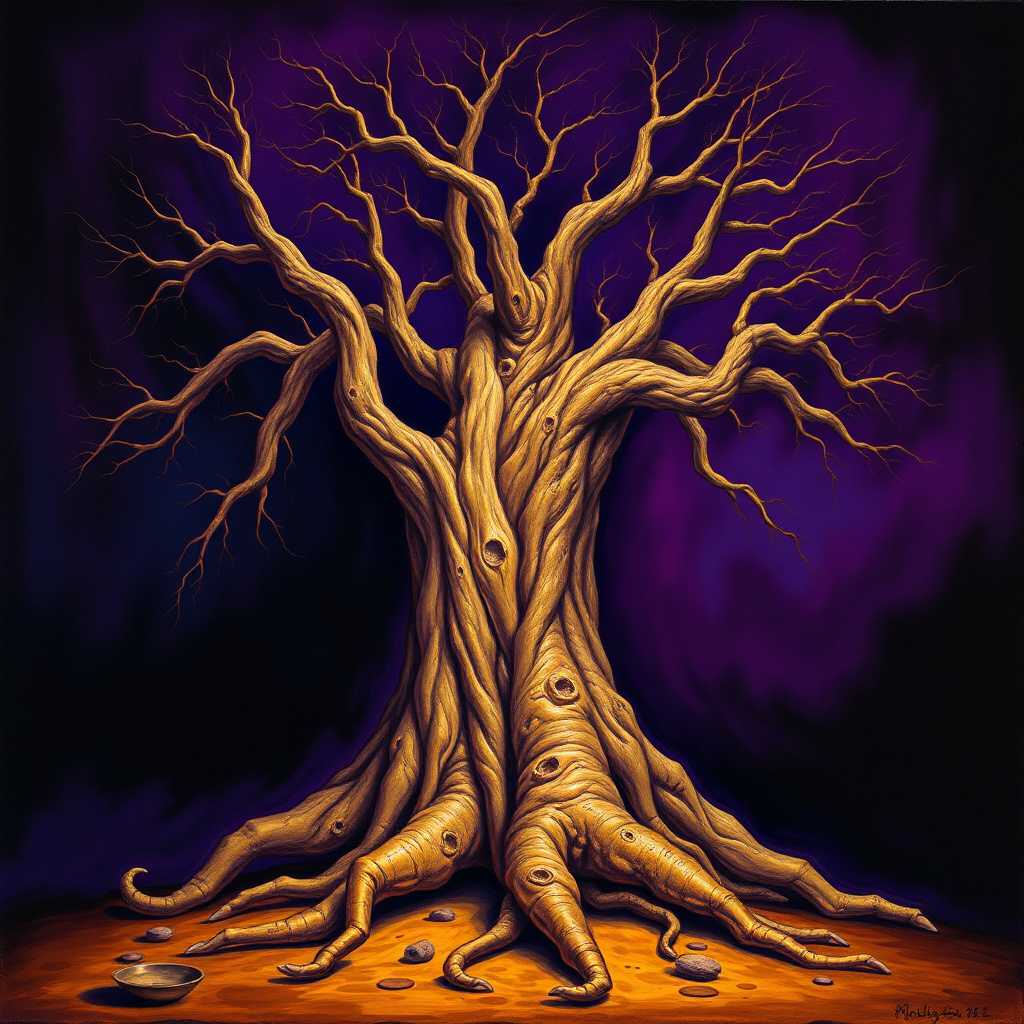
Wood Dream Meaning: A Jungian Archetypal Analysis
Explore the psychological significance of wood in dreams through a Jungian lens, examining its role as a psychic structure and an archetype of individuation.
In the realm of depth psychology, wood serves as a potent material symbol of the psyche's structural integrity and organic growth. Rather than a mere object, wood functions as a bridge between the conscious ego and the unconscious depths. To encounter wood in a dream is to confront the substance of the self—the material that is both shaped by external forces and driven by internal, biological imperatives. Analyzing this symbol requires moving beyond surface-level associations to investigate how it mirrors the complex, layered architecture of the human soul and the process of psychic maturation.
What does your Wood dream mean?
In what state is the wood appearing in your dream?
Wood as the Structural Foundation of the Ego
From a Jungian perspective, wood acts as a metaphor for the ego's framework, representing the tension between the rigidity required for stability and the flexibility needed for survival. Just as wood provides the skeletal support for biological organisms, the psychological 'wood' in a dream often reflects the strength or fragility of the dreamer's current psychic boundaries. If the wood appears seasoned and sturdy, it suggests a well-integrated ego that has undergone the necessary tempering of life experiences. Conversely, decaying or splintering wood may indicate a breakdown in the ego's ability to contain the influx of unconscious material. Carl Jung often emphasized the importance of 'containment' within the psyche; wood, as a medium that can be both a protective vessel and a structural beam, illustrates this capacity. In the process of individuation, the dreamer must develop a 'wooden' core—a sense of self that is firm enough to withstand the pressures of the Shadow, yet organic enough to remain connected to the life force. This is not a static state but a dynamic equilibrium. In waking life, one might build a house of wood to find shelter, but in the dreamscape, the wood is the very substance of the dreamer's psychological house. It is the material through which the anima or animus might find expression, carving out shapes within the dense forest of the unconscious. To engage with wood is to engage with the very grain of one's character, examining whether the internal structure is built upon the solid rings of lived experience or the hollowed-out cavities of repressed impulses and unexamined shadows.
The Organic Archetype and the Process of Individuation
Wood is inherently an organic symbol, embodying the teleological drive of the psyche toward wholeness. Unlike stone, which is inert, wood is a record of time, marked by rings that signify years of expansion, trauma, and resilience. This mirrors the Jungian concept of individuation, where the soul undergoes a series of developmental stages to achieve a unified state. When wood appears in a dream, it often signifies the 'growing pains' of the psyche. The grain of the wood represents the specific, idiosyncratic path of the individual's development, tracing the movement from the collective unconscious toward a highly differentiated self. This is the intersection of the biological and the spiritual. The wood represents the 'living' quality of the psyche—it is something that was once part of a larger forest (the collective) but has become a distinct entity through the process of growth and death. Jungian analysts might view the texture of the wood as an indicator of the dreamer's relationship with their instinctual nature. Smooth, polished wood suggests a high degree of sublimation, where raw psychic energy has been refined into civilized form. Rough, bark-covered wood suggests a closer, perhaps more unrefined connection to the primal, instinctual layers of the unconscious. The archetype of wood thus mediates between the solar, conscious aspects of the personality and the lunar, nocturnal depths of the shadow. It is the medium through which the psyche 'grows' into its destined form, absorbing the environment while maintaining its unique, structural identity through the cyclical patterns of life, death, and rebirth inherent in all arboreal life.
The Shadow and the Materiality of the Unconscious
The darker aspects of wood—the rot, the knots, and the dense, impenetrable thickets—serve as powerful representations of the Shadow. In Jungian theory, the Shadow consists of those parts of the personality that the ego finds unacceptable or unrecognizable. In the dreamscape, wood that is blackened, petrified, or infested with decay points toward the neglected or repressed elements of the self that are attempting to integrate into the conscious awareness. A knot in the wood is not merely a flaw; it is a point of concentrated tension, a site where the grain has been forced to divert around an obstacle. Psychologically, these knots can represent 'complexes'—autonomous clusters of energy within the psyche that disrupt the smooth flow of consciousness. To encounter wood in its most primal, unworked state is to face the raw materiality of the unconscious. It is the 'prima materia' of the alchemical process, the substance that must be worked, carved, and refined to create something of value. If the wood in a dream feels oppressive or claustrophobic, it may indicate that the dreamer is being overwhelmed by the density of their own unconscious contents. The task of the dreamer is to act as the craftsman, using the tools of awareness to shape the raw, often frightening material of the shadow into a coherent part of the total personality. This work requires acknowledging that the 'rot' is as much a part of the wood's history as the strength of its heartwood. Without the decay, there is no soil; without the shadow, there is no depth. The wood, therefore, stands as a testament to the necessity of integrating both the light and the dark to achieve psychic equilibrium.
Frequently Asked Questions
What is the wood dream meaning regarding personal growth?
From a Jungian perspective, wood signifies the organic maturation of the psyche. The rings within the wood act as a metaphor for the stages of individuation, showing how your experiences—both joyful and traumatic—have contributed to the structural density of your character and your movement toward wholeness.
How does a dream about wood relate to the Shadow archetype?
Wood often manifests the Shadow through its imperfections. Rot, decay, or knots in the wood represent repressed complexes or unexamined aspects of your personality. These 'flaws' are actually vital indicators of where your psychic energy is stuck and where integration is required for growth.
Why might wood appear as a structural symbol in my dreams?
Wood represents the framework of your ego. It illustrates how you are currently constructing your identity and how much stability you possess. The condition of the wood (sturdy vs. splintering) reflects your capacity to contain unconscious impulses while maintaining a coherent sense of self.