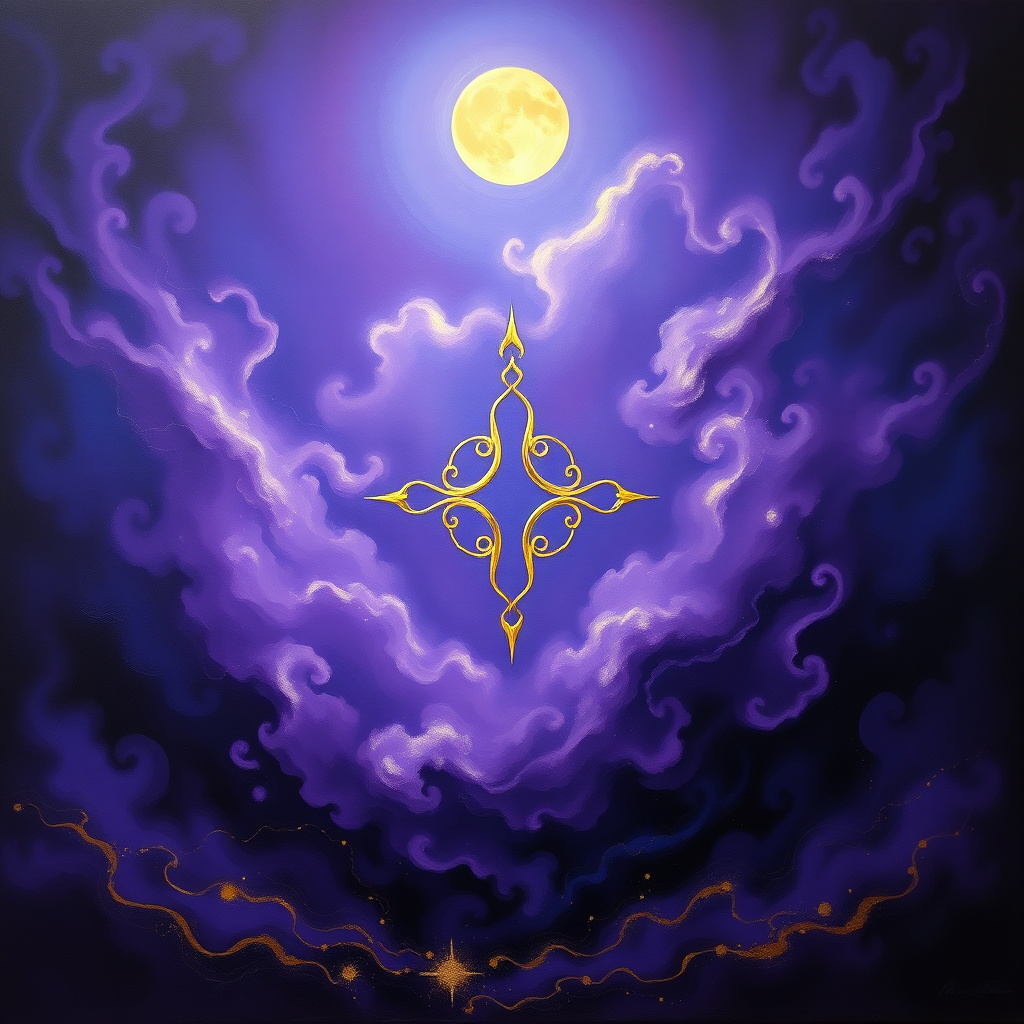
The Evolution of Shape in Dream Interpretation: From Divine Geometry to Neural Patterns
Explore how the meaning of Shape in dreams has shifted from ancient divine omens and Victorian spiritualism to modern neuroscientific perspectives.
The concept of Shape has undergone a radical metamorphosis in the annals of human consciousness. What was once perceived as a direct communication from the cosmos has been recontextualized through the lenses of theology, mysticism, and eventually, biology. To understand the significance of a Shape appearing in a dream is to trace the lineage of human perception itself. We move from the rigid, sacred geometry of antiquity to the fluid, subconscious abstractions of the modern era, observing how our interpretation of form reflects our changing relationship with the unseen world.
What does your Shape dream mean?
Select the primary structural quality of the Shape:
The Sacred Geometry of Antiquity and Medieval Omens
In the classical era, particularly within Greek prophetic traditions, a Shape was rarely viewed as a mere visual byproduct of sleep. Instead, it was treated as a 'logos'—a divine blueprint or a celestial signature. When a dreamer encountered a specific geometric form, such as a circle or a triangle, it was interpreted as an architectural fragment of the universe's fundamental order. The Greeks viewed these forms as manifestations of cosmic stability; a perfect sphere was not a psychological construct but a glimpse into the mathematical perfection of the gods. The interpretation was external and objective. If a Shape appeared, it was an omen sent from the heavens to dictate the structure of earthly events. As the timeline progressed into the Medieval period, this externalized view shifted toward the theological. The Shape became a vessel for moral and spiritual truths. A square might represent the terrestrial realm or the four corners of the earth, while certain complex polyhedrons were linked to the hierarchies of angels or the divine structure of the soul. During this era, the Shape acted as a semiotic bridge between the mundane and the miraculous. There was no concept of the 'subconscious' as we understand it; rather, the Shape was a coded message from a higher plane. To encounter a Shape in a dream was to participate in a sacred dialogue where the geometry itself held the weight of prophecy. The focus remained entirely on the external validity of the form—its perfection or its distortion served as a direct indicator of divine favor or impending cosmic disorder, rather than a reflection of the individual's internal mental state.
Victorian Spiritualism and the Ethereal Silhouette
The 19th century introduced a pivotal shift in how the Shape was perceived, moving away from rigid theological dogma toward the fluid realms of Victorian spiritualism and early psychical research. During this period, the Shape began to lose its strictly mathematical divinity and started to acquire an ethereal, ghostly quality. Mediums and spiritualists often described seeing 'forms' or 'shapes' in the periphery of their trance states, interpreting these silhouettes as the lingering impressions of departed souls or astral travelers. The Shape was no longer just a cosmic law; it was a medium of communication for the 'other side.' Unlike the ancient Greeks who saw geometry as an absolute truth, the Victorians viewed the Shape as something liminal and shifting. It was the boundary between the visible and the invisible. Interpretation moved into the realm of the 'aura' and the 'specter.' A vague, nebulous Shape was not seen as a mathematical error, but as a sign of a spirit struggling to manifest within the physical density of the material world. This era bridged the gap between the external deity and the internal psyche. While still looking outward toward a spiritual dimension, the focus became more individualized. The Shape was seen as a unique signature of a specific entity or a particular energy. This period laid the groundwork for the idea that forms could carry emotional or spiritual weight that was not purely mathematical, setting the stage for the eventual descent of the Shape into the depths of the human mind, rather than the heights of the heavens.
Modern Neuroscience and the Cognitive Architecture of Form
In the contemporary era, the interpretation of Shape has undergone a total paradigm shift, moving from the celestial to the biological. Modern neuroscience has largely stripped the Shape of its prophetic and spiritual mantle, reclassifying it as a product of the brain's visual processing systems and pattern-recognition software. When a Shape appears in a dream, current scientific thought views it through the lens of the ventral stream—the part of the brain responsible for object recognition and form perception. The Shape is seen as a neural byproduct, a result of the brain attempting to make sense of stochastic firing patterns during REM sleep. Rather than being a message from a god or a ghost, the Shape is now understood as a cognitive construct. We look at how the brain utilizes 'Gestalt' principles—the tendency to organize visual elements into groups or unified wholes—to create meaning. In this view, a Shape is a manifestation of the mind's inherent drive toward order amidst the chaos of neural activity. The interpretation is entirely internal and mechanistic. We analyze how the brain's inability to process complex environmental data during sleep leads to the creation of simplified, abstracted forms. The 'meaning' of a Shape is found in the architecture of the human cortex and the way it maps spatial relationships. While this may seem to strip the mystery from the experience, it offers a new kind of wonder: the realization that the very ability to perceive and dream of Shape is a fundamental, hard-wired feature of our biological evolution, a testament to the brain's relentless pursuit of structure.