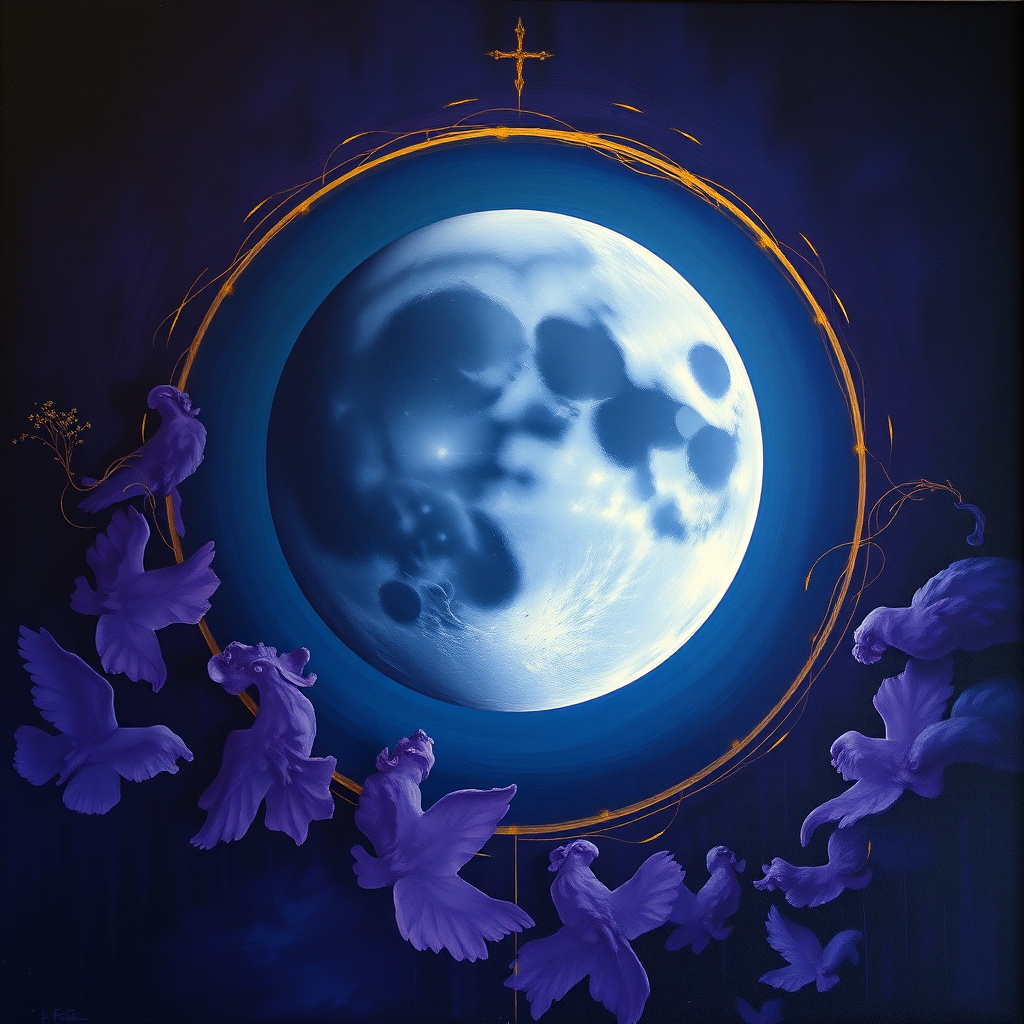
Moon Dream Meaning: A Jungian Archetypal Analysis
Explore the psychological depth of the Moon symbol through a Jungian lens, focusing on the anima, the shadow, and the process of individuation.
In the landscape of depth psychology, the Moon serves as a potent celestial mirror for the internal psyche. Rather than a mere celestial body, it functions as a structural archetype within the collective unconscious. To encounter the Moon is to encounter the reflective, non-rational aspects of the self. It acts as a gateway to the subterranean layers of the mind, where the ego's light fades and the lunar light of the unconscious begins to illuminate the hidden contours of personality, instinct, and the unintegrated parts of the human experience.
What does your Moon dream mean?
Identify the primary lunar quality felt in the psyche:
The Lunar Mirror of the Anima and Animus
From a Jungian perspective, the Moon often manifests as a projection of the anima or animus, the contra-sexual archetypal component of the psyche. For the masculine ego, the Moon represents the anima—the feminine principle of intuition, emotion, and relational depth that resides in the unconscious. It is not a literal woman, but the psychological 'soul-image' that mediates between the conscious ego and the vast depths of the collective unconscious. When the Moon appears with intense luminosity, it may signal a period where the dreamer is becoming more attuned to these internal affective currents, allowing the anima to guide the individual toward greater emotional complexity. Conversely, a waning or eclipsed Moon might suggest a withdrawal of this psychic energy, indicating that the connection to the soulful, intuitive aspects of the self has become obscured by excessive rationalism or ego-dominance. This is not a matter of biological gender, but of psychological polarity. The Moon provides the rhythmic, cyclical framework through which these internal figures communicate. In clinical practice, understanding the Moon as a vessel for the anima allows for a deeper investigation into how a person relates to their own irrationality and their capacity for empathy. The Moon does not generate its own light; it reflects. Similarly, the anima reflects the light of the psyche back to the ego, showing the individual what they have neglected in their pursuit of conscious achievement. By engaging with the lunar archetype, the individual begins to integrate the fluid, receptive qualities necessary for a balanced psychic economy, moving away from the rigid solar dominance of the ego toward a more nuanced, nocturnal understanding of the self.
The Lunar Shadow and the Unseen Self
The Moon is inextricably linked to the Shadow, the repository of all qualities, impulses, and memories that the conscious ego deems unacceptable. While the Sun illuminates what we wish to present to the world, the Moon governs the territory of the dark, the hidden, and the instinctual. The craters and shadows on the lunar surface serve as perfect metaphors for the 'blind spots' in our personality. In Jungian theory, the Shadow is not inherently evil, but it is certainly unknown. When the Moon dominates the psychic landscape, it often indicates that the Shadow is demanding recognition. The lunar phases—waxing, full, and waning—parallel the way shadow material moves from the periphery of awareness into the center of the ego's experience. A dark Moon or a New Moon phase suggests a period of intense shadow work, where the contents of the unconscious are most dense and least visible, yet most potent. This is the stage of the 'nigredo' in alchemical terms, where the old self must undergo a dissolution before rebirth. To ignore the lunar shadow is to allow it to act out through projection in waking life, where we attribute our own repressed traits to others. However, by acknowledging the Moon as the domain of the shadow, the individual can begin the process of 'shadow integration.' This involves bringing the lunar, instinctual energies into the light of consciousness, not to destroy them, but to domesticate them. The goal is to transform the frightening, chaotic darkness of the lunar night into a productive, creative force that informs the character's depth and authenticity, ensuring that the unconscious is no longer a source of sudden, eruptive neurosis but a stable foundation for the self.
Lunar Cycles and the Path of Individuation
The concept of individuation—the lifelong process of becoming an undivided, whole psychological entity—is deeply reflected in the cyclical nature of the Moon. Jung emphasized that the psyche is not a static entity but a dynamic system governed by rhythmic movements. The Moon’s phases provide a structural template for this psychic movement. The process of individuation requires a constant movement between the solar (conscious/ego) and the lunar (unconscious/self) realms. A person stuck in a purely solar existence lacks depth and becomes brittle; a person lost in a purely lunar existence becomes unmoored from reality. The Moon facilitates the necessary tension between these two poles. As the Moon moves through its cycles, it mirrors the ego's journey of shedding old identities (waning) and cultivating new psychic potential (waxing). This is the movement toward the 'Self,' the central archetype that encompasses both the ego and the unconscious. The Moon acts as a regulator of this psychic tempo, reminding the individual that growth is not linear but spiral. There are periods of darkness, reflection, and descent into the unconscious that are just as vital as periods of outward expansion and achievement. In the context of the collective unconscious, the Moon represents the primordial rhythms that connect the individual to the shared history of the human species. By aligning with these internal lunar rhythms, the individual moves away from social conformity and toward a unique, authentic existence. The Moon thus serves as a cosmic clock for the psyche, signaling when it is time to withdraw from the world to integrate new insights and when it is time to emerge, transformed, into the light of a more integrated consciousness.
Frequently Asked Questions
What is the moon dream meaning in a psychological sense?
Psychologically, the Moon represents the unconscious mind and its archetypal contents. It acts as a symbol for the anima/animus and the shadow, reflecting the parts of the psyche that are not immediately accessible to the conscious ego. It signifies the cyclical, emotional, and instinctual dimensions of the human experience that balance the rational, solar aspects of personality.
How can I interpret a dream about moon phases?
Interpreting moon phases involves looking at the direction of psychic energy. A waxing moon suggests an increase in unconscious awareness or the growth of a new psychic complex. A waning moon suggests a period of shedding, letting go of old patterns, or the receding of certain emotional energies to allow for internal reorganization and reflection.
What does it mean to dream about a dark or eclipsed moon?
A dark or eclipsed moon often points to the Shadow archetype. It suggests that significant psychic material is being hidden or repressed. This may indicate a period where the connection to the intuitive self is severed, or it may signal a necessary descent into the 'dark night of the soul' to facilitate deep, transformative psychological work.