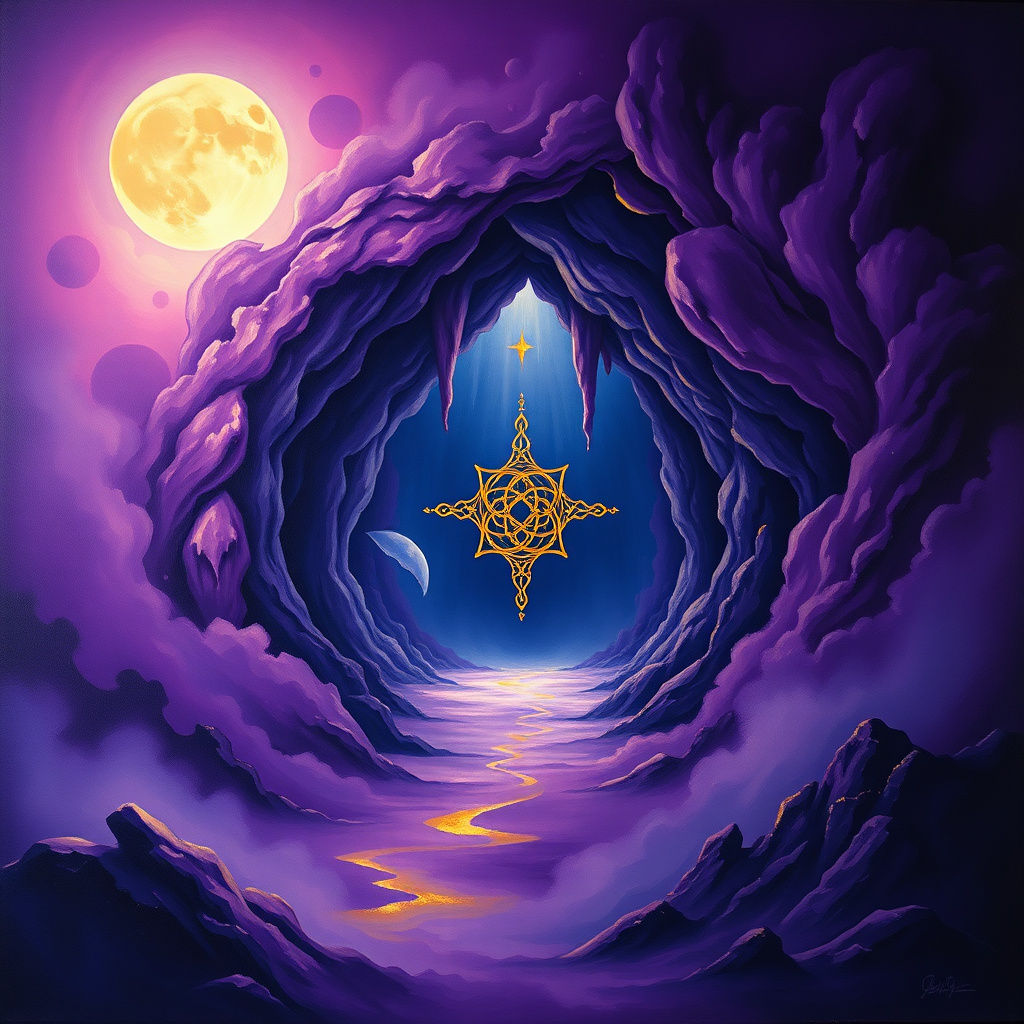
Cave Dream Meaning: An Evolution of Interpretive History
Explore how the meaning of a cave in dreams has evolved from ancient prophetic omens to modern neurological perspectives and psychological landscapes.
To encounter a cave within the theater of sleep is to engage with one of humanity's oldest archetypal structures. This geological hollow has served as a vessel for diverse meanings depending on the era of the dreamer. Rather than a static emblem, the cave acts as a historical mirror, reflecting the shifting priorities of human consciousness. From the divine whispers of antiquity to the synaptic firing patterns of the contemporary age, the interpretation of this subterranean space has undergone a radical metamorphosis, moving from the external realm of gods to the internal landscape of the mind.
What does your Cave dream mean?
Select the primary atmosphere of the cave:
Antiquity and the Medieval Era: The Cave as Divine Threshold
In the classical world, particularly within Greek prophetic traditions, a cave was rarely viewed as a mere geological feature. Instead, it functioned as a liminal threshold between the terrestrial realm and the divine or chthonic underworld. To dream of a cave was often interpreted as an invitation to receive oracles. The darkness within was not seen as a void of nothingness, but as a dense medium through which gods communicated. The cave was a sacred site of gestation and revelation, where the veil between mortal perception and cosmic truth was thinnest. A dreamer entering a cavern was perceived as being pulled into a ritualistic space where the laws of the waking world ceased to apply. As history transitioned into the Medieval period, this interpretation shifted toward the theological. The cave became a site of asceticism and spiritual testing. In the Christianized worldview, the cave might evoke the Nativity or the tomb, representing a space of profound isolation necessary for religious devotion or a site of mortality and resurrection. The darkness was no longer just an oracle's medium but a testing ground for the soul's endurance against temptation. In this era, the cave was an omen of spiritual gravity, suggesting that the dreamer was undergoing a period of intense moral or religious reckoning. It was a place of hiding, of sanctuary, or of the grave, always tethered to a higher, external power that governed the movement of the spirit through the dark. The focus remained steadfastly outward, viewing the cavern as a physical manifestation of a divine or supernatural geography that the dreamer was temporarily traversing.
Victorian Spiritualism and the Romantic Shift: The Cave as the Unconscious Soul
The 19th century brought a dramatic pivot in how the cave was understood, driven by the rise of Romanticism and the burgeoning field of spiritualism. No longer just a site of divine oracles or religious testing, the cave began to represent the vast, untamed territories of the individual psyche. Victorian thinkers, fascinated by the 'sublime,' saw the cave as a metaphor for the hidden depths of the human character—the parts of the self that remained unlit by the rational sun of Enlightenment thought. During this period, dreaming of a cave was often linked to the exploration of the 'shadow self' or the untapped emotional reserves of the individual. Spiritualists might have viewed the cavernous space as a medium for communicating with the departed, treating the cave as a psychic portal to the ether. However, the prevailing cultural mood was one of intense introspection. The cave became a symbol of the interiority of the soul, a place where one might encounter their own repressed passions or forgotten memories. This era moved the interpretation away from the external gods and toward the internal mystery of the person. The darkness was no longer a divine presence but a psychological state—a state of melancholy, solitude, or profound self-discovery. The cave served as a landscape for the 'inner wanderer,' mirroring the Victorian preoccupation with the tension between societal decorum and the wild, subterranean impulses of the human heart. It was a space of profound privacy, representing the sanctity and the terror of the individual's own unmapped emotional terrain.
The Modern Era: Neuroscience and the Mapping of the Synaptic Cave
In the contemporary age, the interpretation of a cave has undergone a final, radical deconstruction through the lens of neuroscience and cognitive psychology. The focus has shifted entirely away from omens, spirits, or even the romanticized soul, moving toward the biological mechanics of the brain. Today, a cave in a dream is often analyzed as a structural metaphor for the brain's own architecture or the process of information retrieval. From a neurological perspective, the cavernous space may reflect the way the mind organizes complex, deep-seated data within the long-term memory storage systems. The darkness is not a spiritual void but the absence of sensory input during the REM cycle, or the 'noise' of synaptic pruning. Modern theorists might view the cave as a representation of the 'black box' of cognitive processing—the gap between stimulus and response. While psychological frameworks still utilize the concept of the unconscious, they do so through a secular, functionalist lens, seeing the cave as a way for the brain to simulate environments to test survival instincts or to process emotional stressors in a controlled, low-stimulus environment. The emphasis is on the brain's attempt to make sense of its own internal complexity. We no longer look to the heavens or the spirit world to explain the cave; instead, we look to the folds of the cerebral cortex. The cave has become a map of neural pathways, a visual shorthand for the way the human organism navigates the vast, dark, and highly complex landscape of its own biological hardware and software.
Frequently Asked Questions
What is the meaning of a dream about cave and water?
Historically, the presence of water within a cave has been viewed as a confluence of two powerful elemental forces. In ancient contexts, this often signified a cleansing ritual or a direct connection to the primordial waters of creation. In modern psychological terms, water within a cave typically relates to the movement of emotions through the deep, hidden layers of the subconscious mind.
What does it mean if I dream about a cave with water filling it?
When a cave is characterized by rising or flooding water, the interpretive focus shifts to the overwhelming nature of the environment. Historically, this was seen as a sign of uncontrollable natural or divine forces. Today, it is often interpreted as a representation of emotional inundation, where the 'hidden' parts of the psyche are being flooded by intense, unprocessed feelings.
How should I interpret a dream about a cave?
To interpret a cave, one must consider the historical lens being applied. Are you viewing it as a site of external revelation (ancient), a landscape of the individual soul (Victorian), or a reflection of cognitive processing (modern)? Understanding which era's perspective resonates with your current waking life context can help clarify the symbol's relevance to your experience.