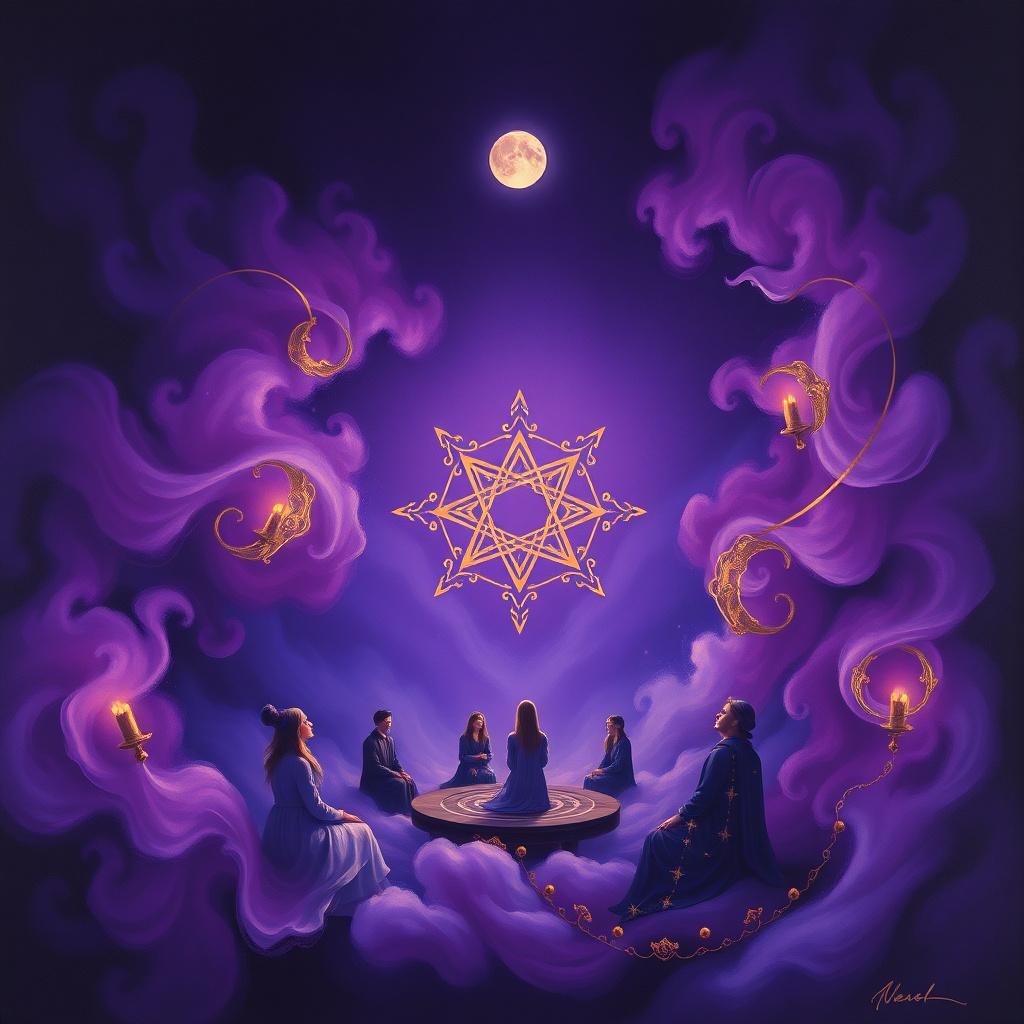
Meeting: A Historical Evolution of Interpretive Frameworks
Trace the evolution of the Meeting symbol from ancient prophetic omens and Victorian spiritualism to modern neurobiological perspectives.
The concept of a Meeting in the sleeping mind has undergone radical shifts in human understanding. Once viewed as a direct conduit to the divine or a harbinger of destiny, the interpretation of such an encounter has migrated through various cultural lenses. From the rigid prognostications of antiquity to the psychic mediumship of the nineteenth century and the data-driven cognitive science of today, the Meeting serves as a focal point for how humanity perceives its connection to the external world and the internal self.
What does your Meeting dream mean?
What is the primary nature of the encounter?
Antiquity and the Medieval Era: The Meeting as Divine Decree
In the classical period, specifically within Greek and Roman traditions, a Meeting was rarely viewed as a subjective psychological event. Instead, it was treated as an objective, external visitation. To experience a Meeting in sleep was to be summoned by the gods or to encounter a messenger from the underworld. The interpretation focused on the 'theophany'—the manifestation of a deity. If a person encountered a figure in a dream, it was not an internal projection but a literal, external entity crossing the threshold of reality to deliver a specific command or prophecy. The weight of the Meeting was tied to its accuracy in predicting geopolitical shifts or personal fates, much like how a sudden diplomatic summit in waking life alters the course of nations. As the era transitioned into the Medieval period, this prophetic weight shifted toward the theological. The Meeting became a site of moral scrutiny. An encounter might be interpreted as a visitation by an angel or a temptation by a demon. The distinction between these two types of Meetings was paramount, as one signaled divine favor while the other warned of spiritual peril. In both eras, the Meeting was an ontological event—a factual occurrence in the fabric of the universe that demanded immediate, ritualistic, or ethical responses from the dreamer. The focus remained entirely on the external source of the encounter, leaving little room for the concept of the individual's own subconscious contributing to the event. The Meeting was a bridge between the mortal realm and the celestial hierarchy, a moment where the veil between worlds became porous and the dreamer became a passive recipient of cosmic truth.
Victorian Spiritualism: The Meeting as Psychic Resonance
The nineteenth century introduced a profound shift in how the Meeting was conceptualized, moving away from rigid religious dogma toward the fluid realms of spiritualism and the burgeoning interest in the 'unseen.' During the Victorian era, a Meeting was often interpreted through the lens of mediumship and the survival of the soul. Rather than a direct command from a distant deity, the Meeting was seen as a localized psychic event—a chance encounter with a departed spirit or an astral projection. This period viewed the Meeting as a form of communication facilitated by the dreamer's heightened sensitivity. It was less about divine prophecy and more about the lingering resonance of human consciousness. In the waking world of the Victorian era, this mirrored the fascination with séances and telegraphic communication; the Meeting in sleep was perceived as a wireless transmission from the 'other side.' This era began to bridge the gap between the purely external divine and the purely internal mind, suggesting that the Meeting was a collision of two distinct energetic frequencies. The dreamer was no longer just a passive recipient of a god's decree, but a participant in a psychic exchange. This interpretation emphasized the emotional and atmospheric qualities of the encounter, suggesting that the 'vibe' or spiritual frequency of the Meeting provided clues about the state of the soul or the presence of a specific departed loved one. The Meeting became a bridge of sentiment and memory, a way to navigate the boundary between the living and the dead through the medium of the nocturnal subconscious.
The Modern Era: The Meeting as Neurobiological Integration
In the contemporary landscape, the interpretation of a Meeting has been stripped of its supernatural mantle and recontextualized through neuroscience and cognitive psychology. Today, a Meeting is understood as a complex neurobiological process involving the integration of disparate neural pathways. Rather than a visitation from a spirit or a god, the Meeting is viewed as the brain's attempt to synthesize information, memories, and emotional stimuli during the REM cycle. It is a manifestation of 'associative processing,' where the mind brings together seemingly unrelated concepts to consolidate learning or regulate emotional states. In this framework, the Meeting is an internal simulation. If a person experiences a Meeting in a dream, modern science looks to the prefrontal cortex and the limbic system to explain the encounter as a byproduct of synaptic pruning or memory encoding. The 'other' in the Meeting is recognized as a construct of the dreamer's own cognitive architecture—a projection of social schemas or internalized archetypes. This mirrors the modern, hyper-connected waking world where information is processed in massive, interconnected networks. The Meeting is no longer an event that happens *to* the dreamer from the outside, but an event that occurs *within* the dreamer's neural network. It represents the brain's method of navigating social complexity and internal conflict through simulated interaction. While the ancient world saw a Meeting as a window to the heavens, and the Victorians saw it as a window to the afterlife, modern science sees it as a mirror of the biological machine, reflecting the intricate, self-contained dance of human cognition and the structural organization of the mind.
Frequently Asked Questions
What is the significance of a dream about meeting someone unknown?
Historically, an unknown figure in a Meeting was seen as a divine messenger or a spirit. In modern psychological terms, an unknown individual is interpreted as a projection of a specific, unacknowledged aspect of your own personality or a cognitive synthesis of social patterns your brain is currently processing.
How does a meeting dream meaning change based on the setting?
Ancient interpretations linked the setting to the realm of the encounter (e.g., a forest suggesting a wild, untamed divine force). Modern neuroscience views the setting as the brain's way of providing context for the neural firing patterns, using familiar or unfamiliar environments to organize the cognitive simulation.
Why do I keep having the same meeting in my dreams?
From a Victorian spiritualist perspective, repetitive Meetings might suggest an unresolved psychic connection or a persistent message from the beyond. From a modern neurobiological standpoint, it indicates a recurring neural loop or an unresolved cognitive knot that the brain is attempting to process through repetitive simulation.