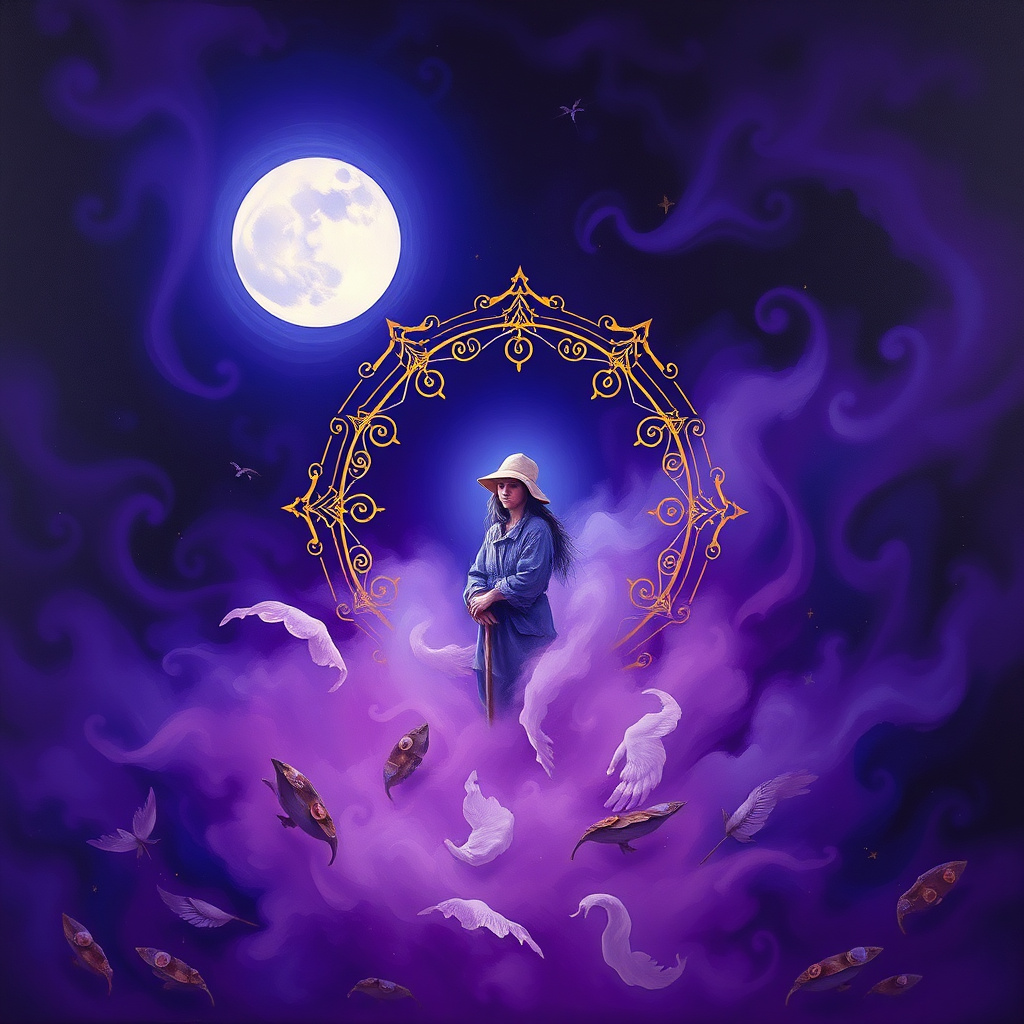
Farmer Dream Meaning: An Evolution of Interpretive History
Explore the shifting historical meaning of the Farmer in dreams, from ancient Greek omens and medieval mysticism to Victorian spiritualism and modern neuroscience.
To encounter a Farmer in a dream is to engage with one of humanity's most enduring archetypes of labor and sustenance. However, the significance of this figure is not static; it functions as a cultural mirror, reflecting the prevailing intellectual frameworks of the era in which the dreamer resides. Understanding the Farmer requires moving beyond simple definitions to observe how the concept has migrated from a divine harbinger of seasonal fate to a neurological byproduct of cognitive processing. This entry traces that chronological trajectory through the lens of human history.
What does your Farmer dream mean?
Select the Farmer's primary activity:
Classical Antiquity and the Medieval Omen
In the era of ancient Greek prophetic traditions, the appearance of a Farmer was rarely viewed as a personal psychological reflection. Instead, it functioned as a macrocosmic signifier. To dream of a Farmer was to receive a communication regarding the state of the polis or the literal viability of the coming harvest. The figure was an agent of the gods, a conduit through which the celestial order dictated the survival of the community. If the Farmer appeared diligent, it signaled divine favor and the alignment of the seasons; if the Farmer appeared distressed, it served as a terrifying omen of drought or plague. This was a period of externalized meaning, where the Farmer stood as a bridge between the mortal realm and the capricious whims of the gods. As the timeline progressed into the Middle Ages, this interpretation shifted toward the moralistic and the allegorical. The Farmer became a central figure in religious dream-lore, representing the cultivation of the soul. The act of tilling the earth was no longer just about physical grain, but about the spiritual preparation of the heart for divine grace. The Farmer served as a pedagogical tool in dreams, illustrating the struggle between virtue and vice. The soil was the human spirit, and the Farmer was the laborer tasked with weeding out sin to allow the seeds of faith to flourish. In this medieval context, the Farmer was a moral compass, guiding the dreamer toward a more disciplined, ascetic existence. The focus moved from the communal survival of the city-state to the individual's salvation, yet the Farmer remained a figure of external authority, dictating the spiritual health of the dreamer through the metaphor of agricultural discipline.
Victorian Spiritualism and the Industrial Shift
The advent of the Victorian era brought a radical reconfiguration of the Farmer symbol, driven by the tension between burgeoning industrialization and the rise of spiritualist movements. As the physical reality of the world moved toward factories and urban density, the Farmer in dreams underwent a dual transformation. On one hand, the Victorian spiritualist viewed the Farmer as a symbol of 'natural law' and an ancestral connection to a lost, pastoral purity. In the séances and dream journals of the 19th century, a Farmer might appear as a mediumistic guide, representing the grounding forces of the Earth that remained untouched by the soot of the steam engine. This was a romanticized interpretation, where the Farmer acted as a tether to a perceived golden age of organic connection. On the other hand, the rapid shift in socio-economic structures meant that the Farmer also began to represent the concept of 'industry' in a more structured, almost mechanical sense. The discipline required to manage land was being mirrored by the discipline required to manage capital. In the dream-logic of the late 19th century, the Farmer began to lose some of its mystical, divine aura and started to embody the concept of long-term investment and the systematic application of effort. The Farmer was no longer just a recipient of divine favor, but a manager of resources. This period marked the beginning of the transition from the Farmer as a sacred figure to the Farmer as a symbol of human agency and the organized management of time and material output, reflecting a society that was increasingly obsessed with progress, productivity, and the mastery of the natural world through systematic labor.
Modern Neuroscience and Cognitive Processing
In the contemporary era, the interpretation of a Farmer has undergone a final, profound shift: the move from the external and spiritual to the internal and neurological. Modern neuroscience and cognitive psychology have largely stripped the Farmer of its status as an omen or a moral guide, reframing the figure as a manifestation of the brain's attempt to organize information. From a neurobiological perspective, dreaming of a Farmer is seen as a byproduct of the brain's 'consolidation' process. The Farmer acts as a cognitive metaphor for the way the mind processes, categorizes, and 'cultivates' new memories and data. When the brain is attempting to integrate complex new information into existing neural networks, the subconscious may utilize the archetype of the Farmer to represent the systematic organization of these mental resources. The 'field' is the vast landscape of the long-term memory, and the 'planting' is the encoding of new synaptic connections. There is no longer a search for divine intent or moral instruction; instead, the Farmer is viewed as a symbol of the brain's inherent drive toward order and pattern recognition. This perspective treats the dream not as a message from the universe, but as a functional simulation. The Farmer represents the cognitive labor of the prefrontal cortex and the hippocampus working to prune away irrelevant data while strengthening useful pathways. Thus, the Farmer has evolved from a god-sent messenger of famine, to a moral teacher of the soul, to a romanticized anchor of tradition, and finally to a sophisticated biological metaphor for the very mechanics of human thought and memory management in a data-driven world.
Frequently Asked Questions
What is the meaning of a dream about farmer?
Historically, the meaning varies by era. In ancient times, it was an omen of survival. In the Middle Ages, it was a moral metaphor for soul-tending. Today, it is often interpreted as your brain's way of processing and organizing new information or 'cultivating' your current life projects.
How does a farmer dream meaning change based on context?
The meaning shifts based on the 'action' being performed. A diligent Farmer might reflect cognitive order or spiritual discipline, whereas a struggling Farmer might indicate mental fatigue or a perceived lack of control over your personal growth and resource management.
Is seeing a farmer in a dream a good or bad sign?
This depends on the historical lens used. To an ancient Greek, it was a sign of seasonal fate. To a modern neuroscientist, it is a neutral sign of cognitive consolidation. It is best viewed as a reflection of how you are currently managing your mental or material 'harvest'.